Crude Oil Refining Units: Mineral Base Oil:
Approximately 95% of the lubricant market consists of mineral base oils. Most people know that these base oils are derived from crude oil reserves, but how many are truly aware of the refining process?
Crude oil flowing from oil wells contains a wide and diverse range of compounds — from light-colored components primarily made up of small hydrocarbon molecular chains to dark substances with large hydrocarbon molecular chains, such as solid asphalts. Crude oil is a highly complex mixture of various hydrogen and carbon compounds. These hydrocarbons vary in size from methane (containing one carbon atom and four hydrogen atoms) to massive structures with 60 or more carbon atoms. This molecular size distribution can be utilized for the benefit of humanity.
The Importance of Refineries
Most lubricating oils are derived from crude oil. In order to obtain a lubricating oil from crude oil, it must pass through a refinery. In the refinery, many molecules with various sizes and structures are obtained from crude oil, each with different applications. For example, gasoline, diesel, and kerosene are all derived from crude oil. Lubricating oil corresponds to hydrocarbon molecules of a specific size (in the range of 26 to 40 carbon atoms). Relatively large and heavy molecules are required for use as lubricating oils. Gasoline and kerosene molecules are smaller and contain fewer carbon atoms in their molecular structure. The refining process separates molecules based on weight and size and removes impurities, producing various products from crude oil.
After crude oil is desalinated and passed through a furnace where it is heated and vaporized, it is directed into a distillation column. This column operates at a pressure slightly above atmospheric pressure and separates hydrocarbons based on boiling points, which are directly influenced by their molecular size. In the distillation column, heat is applied at the bottom end, causing the hydrocarbons entering the column to evaporate. As the vapors move up the column, they cool and recondense into liquids. The point at which condensation occurs varies based on molecular size.
By extracting the condensed liquid from different heights within the column, you are essentially separating the crude oil components based on molecular size. The smallest hydrocarbons (5 to 10 carbon atoms) rise to the very top of the column. They form products such as gasoline. Condensation slightly below the top of the column involves compounds with 11 to 13 carbon atoms, which form kerosene and jet fuel. Heavier hydrocarbons with 14 to 25 carbon atoms in the molecular chain form diesel fuel.
Compounds with 26 to 40 carbon atoms are of interest to lubrication specialists; these materials are used to produce lubricating oils. At the bottom end of the column, the heaviest and largest hydrocarbons (40 carbon atoms and more) are collected and used in asphalt-based products.
After the distillation and separation process, these compounds must be further refined based on their intended use. This stage is carried out to reduce the base oil’s tendency to age (oxidize) during use and to improve viscosity/temperature characteristics. There are two methods to achieve this. The first method involves a separation process that yields two products: a desirable oily product and undesirable byproducts. The second method is a conversion process that transforms structurally undesirable molecules into desirable ones using hydrogen, heat, and pressure.
Method One: Extraction or Separation Process
The diagram below is a simple explanation of the extraction process:

Deasphalting
The propane deasphalting process takes the residue from the bottom-most part of the column (larger and heavier molecules) and converts it into two products: bitumen and compounds similar to oil cuts but with a higher boiling point. These materials are called deasphalted oils and are refined in a similar manner in the lube distillation column.
Solvent Extraction
The term solvent extraction refers to the removal of most aromatics and undesirable compounds through a liquid-liquid extraction process. Commonly used solvents include phenol, furfural, and sulfur dioxide. The products obtained in this stage are raffinate (referred to as neutral oils) and an extract (rich in aromatic compounds), which is used as process oil or fuel.
Dewaxing
After solvent extraction, the raffinate is dewaxed to improve fluidity at low temperatures. This process also produces two products: a wax byproduct, which is fully paraffinic, and dewaxed oil, which contains paraffins, naphthenes, and some aromatics. Dewaxed oil is used as the base in most lubricants, although an additional process is required to produce the final product.
Hydrotreating
This process chemically alters the polar compounds in the oil in the presence of hydrogen. After this process, a light-colored and chemically stable product is obtained. The final quality of the base oil is determined by the temperature and pressure used in the hydrotreating process.
Method Two: Conversion Process
The diagram below is a simple explanation of the conversion process.

Hydrocracking
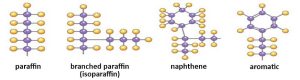
In this refining process, the product obtained from distillation is subjected to a chemical reaction with hydrogen in the presence of a catalyst at high temperature and pressure (420°C and 3000 psi). Aromatic and naphthenic rings are broken, opened, and after bonding with hydrogen, form isoparaffinic structures. The reaction with hydrogen also leads to the removal of water, ammonia, and hydrogen sulfide.
Hydrodewaxing
During the hydrodewaxing process, which is very similar to the hydrocracking process, a hydrogenation unit is used to support the catalyst for converting waxy normal paraffins into highly desirable isoparaffinic structures.
Hydrogen Processing
Since the previous two methods involve breaking the chemical bond between two carbon atoms, it is necessary to introduce saturation of unsaturated molecules. This is easily achieved by introducing additional hydrogen. These saturated molecules are very stable and have greater resistance to oxidation compared to their unsaturated counterparts.
There are slight differences in the specifications of the final base oil produced by the two processes. The most important difference lies in their aromatic content. The conversion process can reduce aromatic content to around 0.5%, whereas the extraction process achieves a reduction of about 15 to 20%. This aromatic content has the following effects:
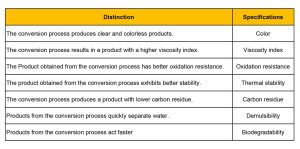
It seems that the conversion process produces a higher quality product, but in the business world, everything is weighed and balanced. The cost of refining oil using the conversion process is somewhat higher than that of the extraction process, and this additional cost incurred by the refinery will ultimately be passed on to the customer. In any case, high-quality base oil will come with higher costs and prices.