Motor Oil Classification Based on Viscosity
Viscosity is the first and most important characteristic that must be considered when working with oils. Having the appropriate viscosity for motor oil under various operating temperature conditions is essential for the proper lubrication of engine moving parts. At the moment the engine is started, its temperature is approximately equal to the ambient temperature, but as the engine operates, the temperature gradually rises. Therefore, motor oil viscosity must be considered under different temperature conditions. The Society of Automotive Engineers (SAE) has classified motor oils based on viscosity and temperature range.
In the SAE viscosity classification system, oils suitable for use in low temperatures are identified with the letter W (Winter). Oils that do not contain the letter W in their grade are suitable for moderate and warm climates and for engine operation at normal temperatures.
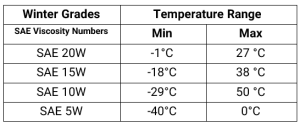
Table 1 shows suitable viscosity grades for summer use, and Table 2 shows suitable viscosity grades for winter use.
Table 1: Suitable Viscosity Grades for Summer Use
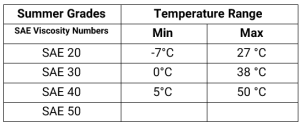
Table 2: Suitable Viscosity Grades for Winter Use
In cold weather, a low-viscosity oil should be used. Using such oil allows the engine to start easily, and the oil quickly reaches all engine parts, ensuring proper lubrication. However, in hot weather, a low-viscosity oil becomes too thin and cannot form a proper lubricating layer. For high temperatures, a high-viscosity oil must be used to prevent the oil from becoming overly thin. On the other hand, when the temperature drops and the engine cools, if the oil has high viscosity, it loses its ability to be pumped. As a result, the oil does not reach all parts quickly enough and causes problems during startup. To avoid such issues, multi-grade oils have been developed.
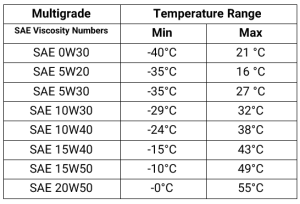
The oils mentioned in Tables 1 and 2 are single-grade oils. Multi-grade oils are made by blending a low-viscosity oil with viscosity index improver polymers. For example, when these polymers are added in an amount sufficient to reach SAE 40 viscosity to a base oil of SAE 15W, the resulting oil behaves like SAE 15W at low temperatures and retains the properties of SAE 40 at high temperatures. This is SAE 15W-40 oil, which can be used over a relatively wide temperature range. In fact, the viscosity of these oils adjusts according to the temperature. Table 3 shows multi-grade oils and their applicable temperature ranges.
Table 3: Multi-Grade Oils and Their Temperature Range of Application
Using multi-grade oils offers several advantages over single-grade oils, including:
• Easier engine starts, which lead to reduced engine wear and extended starter and battery life.
• Reduced fuel consumption (in some cases, fuel savings can reach up to 3%).
• The ability to use a single oil throughout the year with excellent performance at high temperatures
• Reduced oil consumption: The use of polymer additives in engine oil, especially in diesel engines, significantly helps reduce oil consumption. Some of these polymers burn at high temperatures and create carbon layers in the oil ring grooves, aiding in sealing.
From inspecting the body and appearance of the car to maintaining the engine and timely replacement of parts, each plays a vital role in maintaining vehicle performance. One of the key aspects of engine maintenance is choosing the right engine oil and determining the proper time to change it. A fundamental question arises: depending on the engine type and climate conditions, which type of engine oil does a car require, and how should one choose the best oil for each season? Answering this question can greatly enhance vehicle performance and extend its lifespan.
The primary function of engine oil is to lubricate and facilitate the smooth, frictionless movement of various engine components. As a key element in optimal engine performance and health, engine oil performs multiple roles under various climatic and thermal conditions. In cold seasons, it plays a crucial role in cooling engine parts and effectively dissipating the excess heat generated during combustion. It also provides proper sealing between piston rings and the cylinder wall and prevents leakage and performance loss. Furthermore, engine oil can carry out dust, soot, and wear particles from the engine and keep them suspended to prevent buildup. This directly reduces rusting in metal parts and enhances the oil’s ability to absorb shocks caused by engine operation, contributing to longer engine life.
When selecting the appropriate engine oil, considering its viscosity for different seasons is essential. In hot weather, a higher-viscosity oil is needed to prevent it from becoming too thin. For example, in vehicles like the Nissan Maxima, 10W40 oil is recommended for hot climates, while 10W30 is more suitable for moderate and cooler climates. Hence, selecting engine oil according to weather conditions not only helps maintain engine performance but also supports overall vehicle health.
Viscosity is one of the most critical characteristics of engine oil, greatly affecting engine performance and longevity. This feature varies with changing weather conditions, making seasonal oil selection essential. In general, motor oil viscosity is indicated by numbers ranging from 0 to 60: 0 to 25 for cold or winter weather, and 30 to 60 for warm or summer temperatures. Accordingly, motor oils are classified into two categories: single-grade and multi-grade.
Single-grade oils, marked by a single number on the packaging, are tested for use in one specific climate condition — for instance, SAE 10 for warmer weather and up to SAE 25 for colder weather. In contrast, multi-grade oils, denoted by two numbers and a letter (e.g., 10W40), thanks to advanced polymer technologies, can perform well in both seasons. The number before the “W” indicates the oil’s viscosity in cold temperatures, while the number after represents its viscosity in high temperatures. All-season engine oils, capable of operating effectively across various temperature ranges, are recommended by automakers such as Saipa and Iran Khodro. Overall, choosing the best engine oil according to climate conditions significantly helps protect the engine and improve the vehicle’s performance and lifespan.